

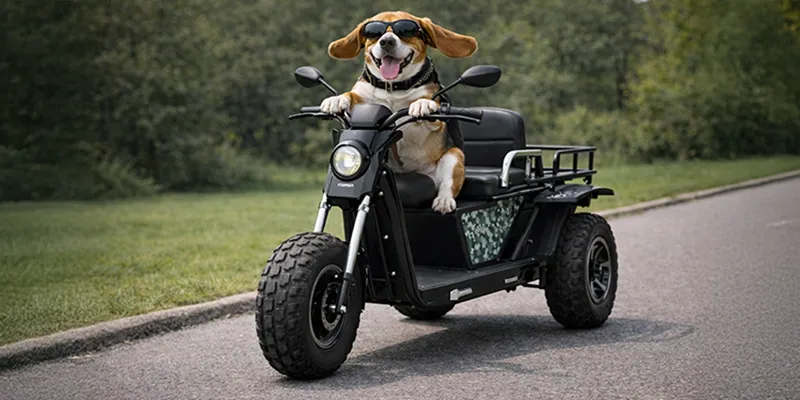
Is a mobility scooter an “automobile” in ordinary parlance such that its operator is entitled to accident benefits? Have a look:
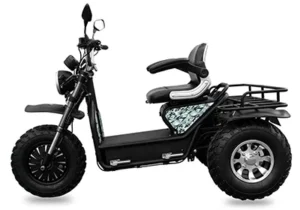
In Bartok v. Intact, the LAT said “yes”.
Readers may recall my earlier post (Ordinary Parlance: Meet the New Face of “Automobile”), where the LAT determined that a CAT 930K front-end loader was an “automobile” in ordinary parlance.
The new decision (by the same adjudicator) appears to double down on that reasoning.
Facts: Mobility Scooter Accident (Daymak Boomer Beast)
The case involved a Daymak “Boomer Beast”, an electric three-wheeled device marketed as a mobility scooter. The applicant was riding it when it allegedly malfunctioned, causing him to fall onto the roadway and sustain injuries. There were no other vehicles involved in the incident.
The insurer denied accident benefits on the basis that the device was not an automobile.
The Tribunal disagreed.
Legal Test: What Is an “Automobile” in Ordinary Parlance?
Because the Statutory Accident Benefits Schedule does not define “automobile,” the Tribunal applied the familiar three-part framework from Adams v. Pineland Amusement Ltd.:
- Is the vehicle an automobile in ordinary parlance?
- If not, is it defined as an automobile in the policy wording?
- If not, does a statute enlarge the definition?
The Tribunal concluded the Boomer Beast satisfied the first step and therefore qualified as an automobile in ordinary parlance.
Tribunal Reasoning: Why the Mobility Scooter Was an “Automobile”
Referring to Grummett v. Federation[1] as authority, the Tribunal focused on the purpose and function of the device. The Boomer Beast has three wheels, handlebars, lights, and a seat, and can travel at speeds of approximately 40 km/h. It is capable of being used on roads and is designed to transport a person.
On that basis, the Tribunal concluded the device was designed for transportation on streets and highways and therefore constitutes an automobile in ordinary parlance.
Why This Decision Misapplies “Ordinary Parlance”
This conclusion is difficult to reconcile with what “ordinary parlance” actually means. “Ordinary parlance” means using common, everyday language that most people understand.
The device in question was often referred to as a mobility scooter. It is operable without a licence and is sold as a mobility aid, not as a motor vehicle requiring insurance. While it could be used on the road, it is hard to imagine that it was intended for road use in the same way an automobile is typically designed for such purposes.
In everyday language, very few people would describe a “Boomer Beast” as an automobile.
The reasoning effectively reduces the ordinary parlance test to a functional checklist: if a device has wheels, a motor, and can travel on a road, it may qualify as an automobile in ordinary parlance. That approach risks stretching the concept well beyond how the term is commonly understood. Put another way, this step in Adams cannot meaningfully be described as an “ordinary parlance” test if the ordinary meaning of the term “ordinary parlance” is not driving the analysis.
Implications: Insurance, Licensing, and Accident Benefits
There is also a broader issue. If a mobility scooter qualifies as an automobile for the purposes of the accident benefits scheme, it raises an obvious question: should it not also be treated as an automobile elsewhere in the motor vehicle regime?
Automobiles must be insured when driven on highways. Plaintiffs who drive their uninsured “automobiles” on highways cannot sue other motorists for personal injuries. Mobility scooter users injured may be excluded from several specified accident benefits. Further, drivers of automobiles typically require a driver’s licence. Yet devices like a mobility scooter are widely sold and used as mobility aids without those requirements. Driving a motor vehicle on a highway without a valid licence can trigger other policy breaches.
Bartok does not address this tension. More fundamentally, there should be little difficulty in applying “ordinary parlance”: the inquiry is how the term is actually used. Treating Grummett’s functional considerations as a checklist risks displacing that common-sense meaning rather than informing it.
Takeaways: LAT Expands “Automobile” to Mobility Scooters
Seen alongside the earlier Tribunal decision involving the CAT 930K loader, the Tribunal’s approach suggests a willingness to interpret the concept of “automobile” broadly where a device resembles a road-going vehicle and can transport a person.
Whether a construction loader—or a mobility scooter—truly falls within what most people would describe as an “automobile” should not be debatable. These are not automobiles in ordinary parlance.
But decisions like this suggest the boundaries of that concept continue to expand. It may ultimately fall to the Divisional Court to restore some meaning to the concept of “ordinary parlance.”
See Bartok v Intact Insurance Company, 2026 CanLII 18343 (ON LAT)
[1] Grummett v. Federation of Insurance Co. of Canada, 1999 CanLII 15103 (ON SC), at para 16,